C 9#11, as the Armonía Takes It
The grip Vihuela uses for C 9#11, and the job it is doing while the chord sounds.
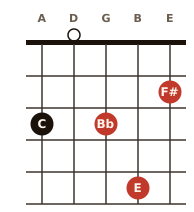
C 9#11 spells C – D – E – F# – G – Bb. Which of those tones reach the air, and in what register, is decided by the section holding them — so the grip below is the answer for one instrument in one section, not a universal fingering.
Inside the armonía this instrument is the top of the armonía — five re-entrant strings whose open third is the highest open pitch on the instrument, so every strum lands as one tight treble block instead of a spread stack, and the shape below is not a voicing choice so much as a section instruction — the whole armonía strikes the same mánico in unison, on the same slot, or the chord stops being one event.
Every shape is drawn for A–D–G–B–E across 5 strings, open positions first and movable ones after them, each with playback. The tuning is re-entrant — string 3 carries the highest open pitch on the instrument, not the last one — so a familiar grip comes out as a closed block rather than a spread stack.